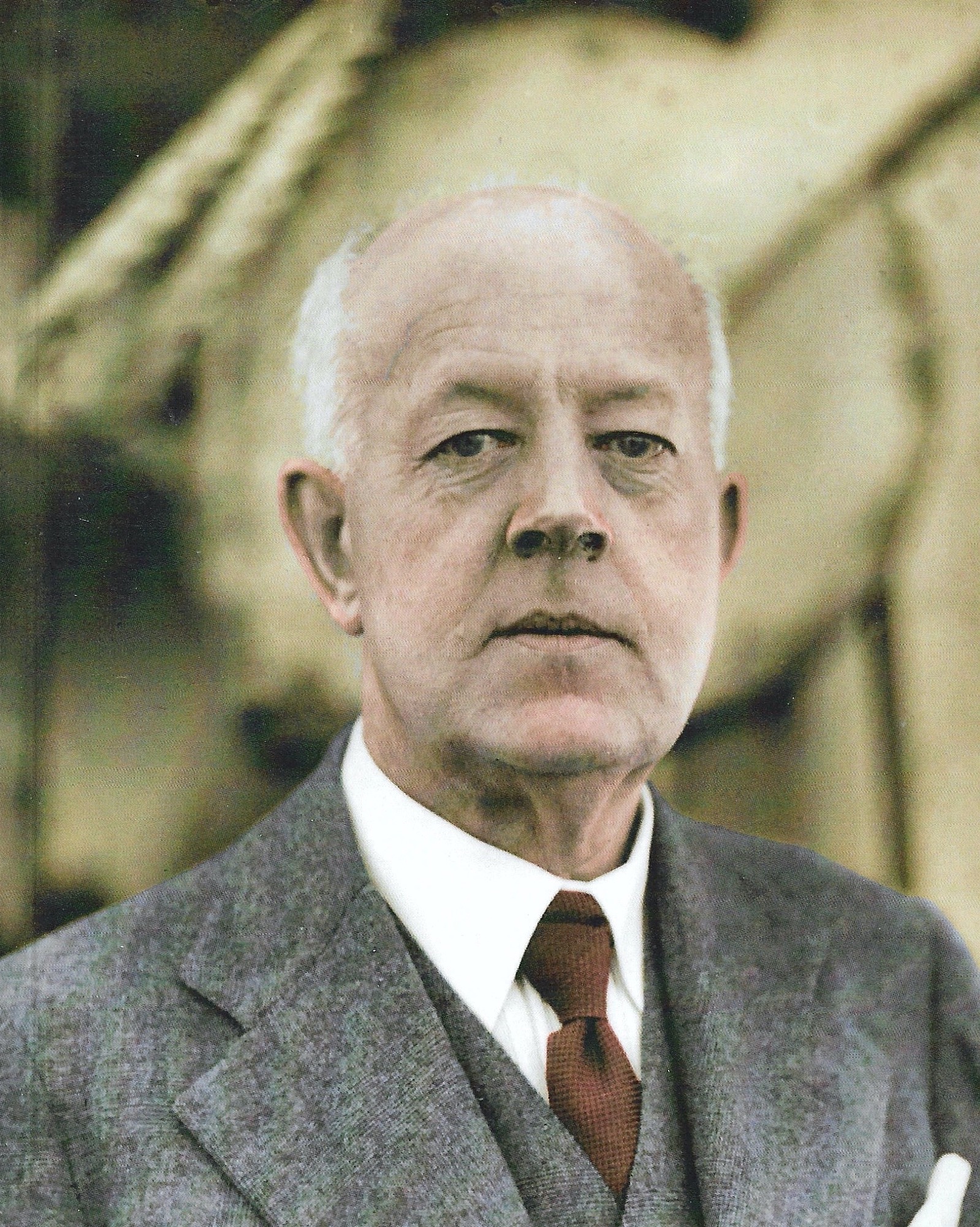
EDGAR BAINTON
MUSICAL AND SPIRITUAL TRAVELLER
Michael Jones
For many people, the anthem And I Saw a New Heaven, a classic of English church music, is all that is known today by the composer, pianist, conductor and teacher, Edgar Bainton. And yet, if we look back 60 years to the many competitive festivals and choral society events that were a vital part of British music-making, his part-songs and choral works were part of the backbone of the repertoire. If we study the anthem a little more closely, surveying the natural shape of the melodies in relation to the words, the imaginative and sensitive harmonic flow, and above all, that other-wordly quality that is such a special characteristic of the piece, and which made it such an appropriate contribution to the Hillsborough Memorial Service at Liverpool's Anglican Cathedral in 1989, we must surely wish to know more about the personality and the music of this elusive figure. Such thoughts prompted the research for this article.
Edgar (Leslie) Bainton was born in London on 14th Feburary 1880; his father was a Congregational minister who later moved with his family to Coventry. His abilities in music and at the piano were noticed early; he made his first public appearance as solo pianist at 9 years of age, and at 16 he won an open scholarship to the Royal College of Music to study piano with Franklin Taylor and theory with Walford Davies. In 1899 he gained the Wilson Scholarship to study composition with Sir Charles Villiers Stanford, and thus became one of the rising generation of British composers destined to contribute extensively to the English Musical Renaissance. Unlike some other students, Bainton did not find Stanford overbearing or restricting, but seems to have derived great benefit from his studies, as he later wrote:
“It is a curious paradox that in spite of his dominating personality (at times aggressively dominating) hardly one of his many pupils' works shows any influence of Stanford... And this fact in itself is surely the finest tribute to his teaching that he kept his own personality in the background and helped them whether they were conscious of it or not to express themselves, to say clearly what they had to say.”
Life at the Royal College was not always easy and he had to supplement his income by undertaking outside engagements, either as accompanist, as drummer in theatre orchestras (he was timpanist in the College orchestra) or on one occasion as organist - playing to Queen Victoria at Balmoral. His college friends included George (later Sir George) Dyson, William H. Harris and particularly Rutland Boughton, who was to be a great help to Bainton's career. His first surviving work is a Prelude and Fugue in B Minor for piano, dating from 1898; it is the first entry in his notebook which lists nearly all his works up to his death, and to which I shall constantly refer.
In 1901 Bainton was appointed piano professor to the Newcastle-upon-Tyne Conservatory of Music (it closed in 1936, two years after his emigration to Australia: more recent information confirms the closure of the Newcastle Conservatoire as 1938: see D.H.Thomas; “The Newcastle Conservatoire of Music”, British Music, vol.14 (1992) page 66-7.). He immersed himself totally in local musical life - becoming pianist and writer of programme notes for the Northumbrian Chamber Music Society in 1909, conductor of the Philharmonic Society (amateur) Orchestra in 1911, and in 1912 the Principal of the Conservatory. He decided to enlarge the facilities there by purchasing a large house in Jesmond Road, a venture which, had it failed, would have ruined him financially. He had married a former student, Ethel Eales, in 1905, and their two daughters, Guendolen and Helen were born in 1906 and 1909. They lived at Stocksfield, near Hexham, where Bainton gained much inspiration from taking long country walks, often with his friend, the Lakeland poet, Wilfred Wilson Gibson; it was through Gibson that Bainton became part of the literary circle surrounding the poet and litterateur, Gordon Bottomley. This connection was to result in Bainton setting many of his poems and writing an opera to one of his lyric dramas. He was also part of an important musical circle for introducing much new British music. Works by Holst, Bax, Vaughan Williams and many others were performed for the first time in the area, largely through the pioneering efforts of Bainton, his close friend William Gillies Whittaker, George and H.Yeaman Dodds, the violinist Alfred Wall, the conductor J.E.Hutchinson and the Cathedral Organist, William Ellis.
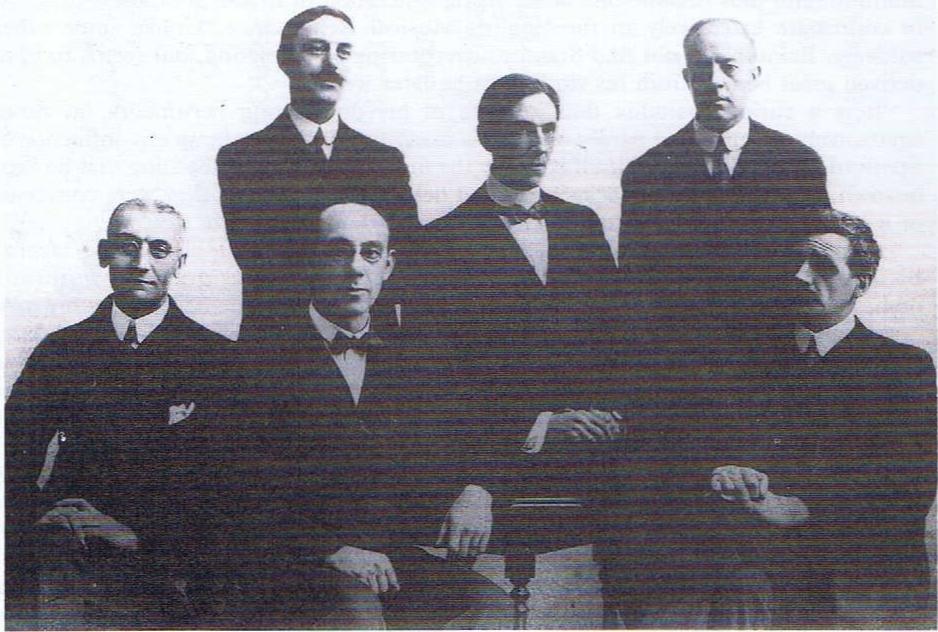
Edgar Bainton, W Gillies Whittaker. 1929.
photo: courtesy of Denis Dodds
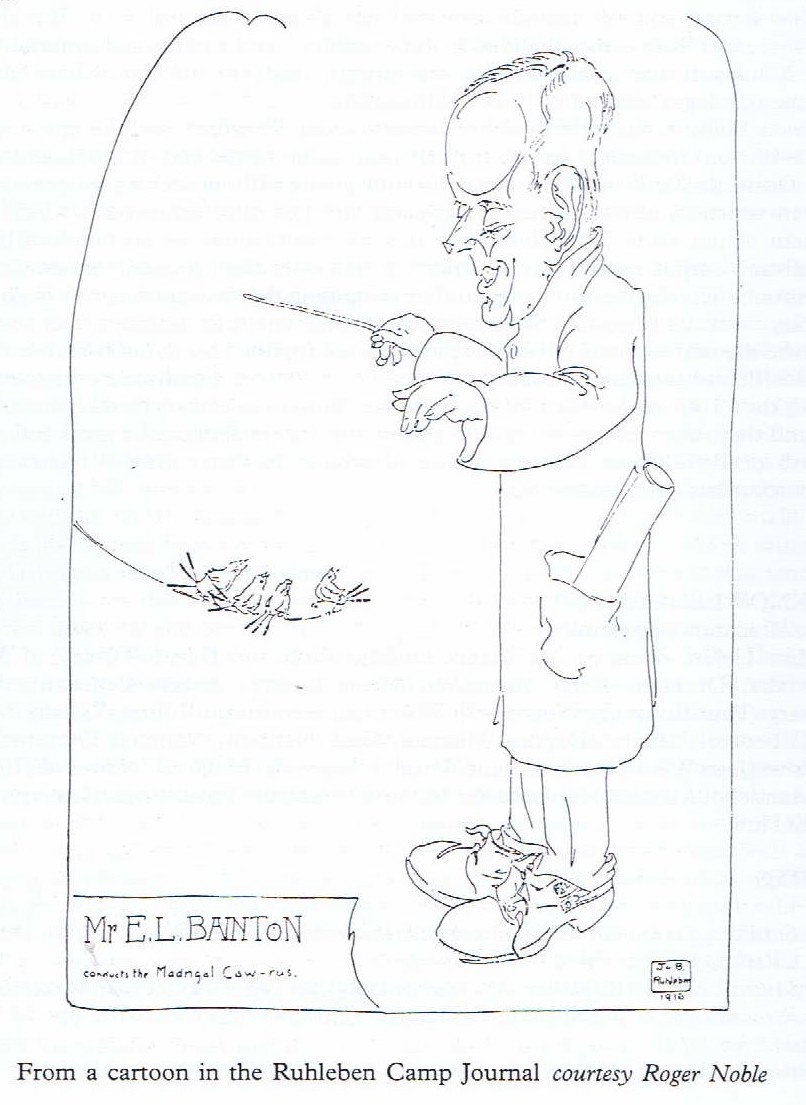
In the summer of 1914, while en route to the Bayreuth Festival, he was arrested as a British civilian in wartime Germany and interned at a prison camp at Ruhleben, near Berlin. This was a converted race-course and internees had to sleep six men to every horse-box. Despite many hardships this four year exile proved to be a period of great creative and practical musical activity, not only for Bainton, who was placed in charge of all the music at the camp, but also for a number of other musicians interned there, including Carl Fuchs (principal cellist in the Halle Orchestra, released after a few weeks), Benjamin Dale, Frederick Keel the singer-songwriter, Percy Hull (assistant to G.R.Sinclair at Hereford Cathedral), Ernest Macmillan and Edward Clark (a colleague from Newcastle, studying with Schoenberg in Berlin, and European correspondent for the Musical Times). Many of these were to figure in Bainton's later career in some way. Bainton directed his own madrigal group, known as Bainton's Magpies, as well as conducting the ad hoc orchestra; he played occasional concertos, such as no. 20 in D Minor K466 of Mozart, reviewed in the camp magazine as:
“...played by Mr.Bainton, whose very fine technique is better suited to pianoforte writing of a more modern character, the vigour and robustness of his playing scarcely compensating for what was lost in the way of delicacy...”2; one wonders what sort of instrument he had to play on!
“The fusion of vocal melody and recitative into a continuously flowing orchestral tissue is a constant delight to the practised ear, and there are resource and invention throughout. The orchestration produces as sustained a succession of beautiful sound as any I have heard in the theatre since I attended an opera by Richard Strauss.” 10
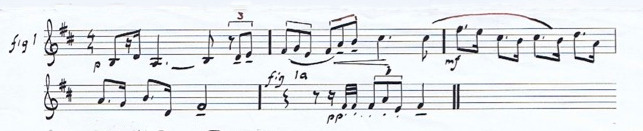
The story is based on an Indian legend and takes place in a Hindu village and later in the jungle near the Jumna river. The story revolves around the love of Krishna, a God in human incarnation, for Radha, a humble cow-girl. His love-song in Act I forms the musical apotheosis to the whole opera, but at this point he plays his flute (Example 1):
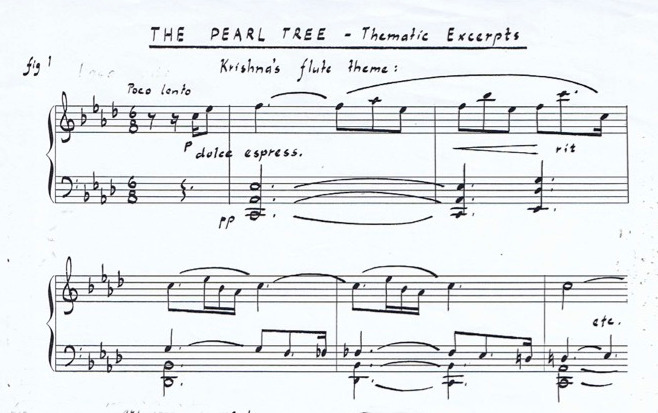
to attract the attention of the Rishi, an ancient hermit and yogi, who sings (in one of the published songs) of his final discovery of God in Krishna himself, after twenty years of waiting. (The spiritual allegory in this work seems to have appealed to one lady observer, who is reported to have commented to the composer that she enjoyed The Pearl Tree as if it were an oratorio!). Sudama, a cowman and friend of Krishna, wishes to adorn his cattle with pearl necklaces to make them more attractive. In the first appearance of the ‘pearl theme’ (Example 2), Krishna asks Sudama to be his messenger to Radha, to request a single pearl in order to grow a pearl tree.
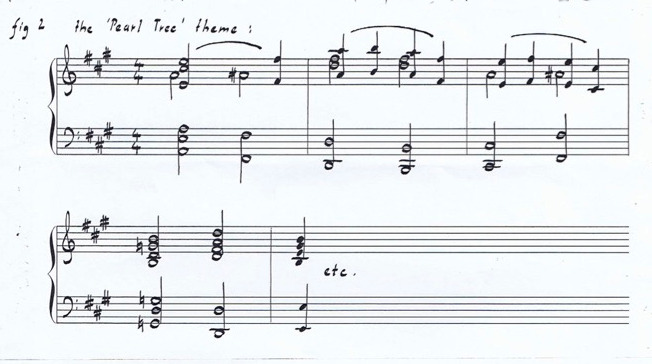
Radha indignantly refuses this request. Yashoda, Krishna's mother, hears of this and gives him a pearl from
her own necklaces which he plants in the ground. As he plays his flute, the Pearl Tree starts to grow, bearing thousands of pearls, to the
delighted astonishment of all onlookers. This is the climax and end of Act I.
At the beginning of Act II (Example 3), Lalita, one of Radha's friends, has witnessed unnoticed the scene of the Pearl Tree and relates the event to Radha, who refuses to believe her.
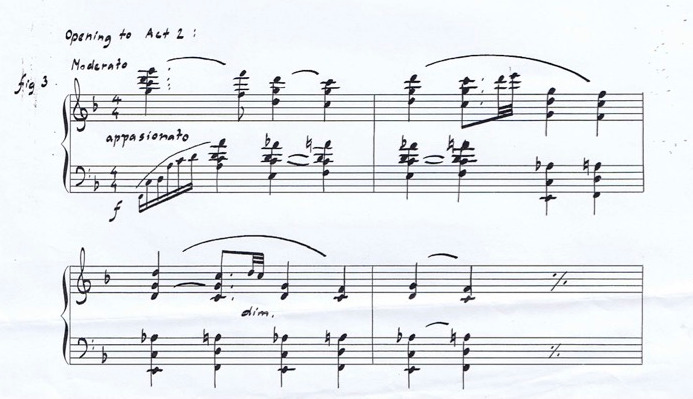
Then, left alone, she begins to regret her selfish pride and unbelief and resolves to seek the Rishi's guidance. On finding him alone in the forest, she asks, “How may I find Krishna?” “That, thou alone canst know,” he says. Slowly the great lights of a celestial city are revealed, their gates guarded by the Asparas, the celestial dancing-maidens. Radha approaches, seeking Krishna, but the Asparas rebuke her for her lack of faith in her divine lover and refuse to admit her. The city vanishes, and in its place the Pearl Tree appears in a radiant light. Radha is greatly humbled by this spectacle and seeks forgiveness from Krishna, who appears (at the sound of Example 1 in the orchestra) and sings his original love-song. As they walk into the forest, Radha offers Krishna her own pearl necklace, but he refuses it, saying, “I need none, for love's pearl once more is mine.”
In view of Bainton's occasional visits to Bayreuth it is not surprising that this opera is built securely on various thematic motifs, as we have just seen; this was the practice with several contemporaries. including Josef Holbrooke and Bainton's friend, Rutland Boughton. The ending, which is reminiscent of Parsifal and even in the same key, with its deeply beautiful and sublime progression of harmonies, is totally equal in power and effect to the sunset ending of Delius's A Village Romeo and Juliet, and is certainly among the finest music written by any British composer this century. Although three songs were published separately (by Nicholson's of Sydney,1945), they are not suitable to stand alone and really do need to be heard as part of the entire structure. For this reason one wonders if the concert performance of mere excerpts, given in Sydney in October 1987, by Australian Opera, with only accompaniment and shorn of its stage decor, could have made any impact at all. There are fine vocal opportunities for the two main characters, but the chorus, consisting exclusively of Radha's and Krishna's friends (girls and boys respectively) are never on stage together as a full chorus. Modern stage technology would make light work of the growing Pearl Tree and the celestial city lights, and a set of performing materials are available from the BMS Archive.
A number of unpublished orchestral works which form a very important part of Bainton's output received occasional performances during the first half of this century; in this respect he was especially fortunate in receiving the support of both Sir Dan Godfrey of the Bournemouth Municipal orchestra, and Sir Henry Wood for the Proms at Queen's Hall, London, as did many aspiring young British composers. His first orchestral piece was Pompilia, which received its première, conducted by Henry Wood, on 8th October, at the 1903 Proms; Henry Wood thought that it “... portrayed so admirably the fundamental idea underlying the narrative in The Ring and the Book...”11. Again we see the inspiration that Bainton derived from literature. We next hear of the première at Bournemouth on October 15th of his early Symphony in B Flat, subtitled A Phantasy of Life and Progress, Op.9. From the programme note we read that the first movement is prefaced by Job 38, verse 7: “When the morning stars sang together, and all the sons of God shouted for joy.” The note goes on to give a good analysis of the music and I am somewhat amused by the remark: “The composer is evidently quite in touch and sympathy with modem art, and does not pin his faith to classical models”(!)12. The second and third movements are prefaced by quotations from Whitman, Byron and Nietzsche; the note also describes the orchestration as requiring extra woodwind (cor anglais, bass clarinet and double bassoon) and “...showing high imaginative powers.”12 Alas, I suspect this rather ambitious work was probably disowned by the composer, as only Pompilia survives of these two works in the Mitchell collection.
The next work to be performed was the Suite, The Golden River Op.16, which was premièred at Bournemouth with the composer conducting, on March 15th, 1909. The story tells of three brothers, the two elder of whom were ugly and evil, while the youngest brother, Gluck, was a beautiful innocent child. It is in four movements, the third of which depicts the two “black brothers” trying to reach the Golden River (a kind of fairy Eldorado) and being turned into black stones. The score and parts are in the Sydney Conservatorium Library and the work is scored for conventional forces with harp and double bassoon. Shortly after The Golden River Bainton composed the Overture-Phantasy, Prometheus, a commission for the 1909 Newcastle Festival where it received its first performance on October 20th, and was repeated at Bournemouth on December 23rd. Again we read of scoring for “a large orchestra” (50 players at Bournemouth) and also that the themes representing Prometheus and his yearning for freedom “are developed with much skill and elaboration, the rhythmic combinations being both interesting and original”, (score in the Mitchell Library). The première of Four Dances also took place in Bournemouth, in December 1910. They were scored for small orchestra and possibly no longer survive. This may also be the case with the Celtic Sketches, first played at the Newcastle Philharmonic Society in February 1912, then at Bournemouth in March and then the Proms on October 10th that year.
While in Ruhleben, Bainton wrote some incidental music for the camp productions of Shakespeare's Merry Wives of Windsor and Twelfth Night; an Intermezzo from the former and a Humoresque from the latter were later to become part of the Three Pieces for Orchestra of 1919, together with an opening Elegy. This piece and the Intermezzo were first performed at the 1919 Proms on 20th September, conducted by Bainton and the first complete performance was at Bournemouth on January 6th 1921, and subsequently for Bainton's first appearance at the Three Choirs Festivals, at Hereford that year. January 1922 at Bournemouth saw the première of Paracelsus (after Browning). This had been written in 1904 but was later re-written and rescored. His next piece, Eclogue, was completed in May 1923 and premièred at the 1928 Proms but is currently missing. (Special note: The first performance currently recorded of Paracelsus took place on 31/08/21,during the 1921 Henry Wood Prom season (cond. E.B.). Bournemouth, however, was the venue for the première of Eclogue on 5th. January 1928 (cond. E.B.)) His last tone-poem, Epithalamion, (from Spenser's Poem) was first performed at the Three Choirs Festival on August 11th 1929. It also featured at the 1932 Proms, and as part of the prestigious BBC British Music Festival of 1931, conducted by (Sir) Adrian Boult. Performing materials are held by ABC Sydney and there is also a broadcast recording which reveals a lively, colourful and cleanly-scored piece, with a lovely middle section based on a duet-interplay for two violins soaring in the fashion of “their merry musick that resounds from far.” Bainton's only published orchestral work is the Pavane, Idyll and Bacchanal for strings with flute solo in the Idyll and additional tambourine in the Bacchanal; this was completed in 1924 and published by Oxford University Press in 1925. These and the earlier three pieces for orchestra have been recorded in Australia, but of these two works, the Pavane, Idyll and Bacchanal is the most immediately attractive and memorable, if lightweight. Sensitively and imaginatively scored, they fully deserve occasional performance as part of a light music programme. The Bacchanal is in 5/4 with occasional shift 2-3 and 3-2, with a well-contrasted and quite beautiful middle section enhanced by the metric alternation.
Bainton's notebook lists very few chamber works. An early Piano Quintet in A of 1904 and a String Quartet, listed as Op.26, of 1911, which received a performance at the Dunhill Chamber Concerts during that period, may no longer survive. We immediately pass on to his three most important works in this genre. The String Quartet in A was completed in Ruhleben in October 1915 and originally stood as a three-movement work in which the opening theme formed the basis of the essential material which returned at the end; in this form it was premièred by the Philharmonic Quartet at the De Lara Chamber Music Concerts Series, on June 25th 1919. Bainton subsequently withdrew the work and by July 1920 it had been thoroughly revised, condensed and a Finale added, which further reworked the opening material. It has been known for a long time in Australia in a recording by the Austral Quartet, but has now been newly recorded for the BBC by the Alberni Quartet for future transmission on Radio 3.
In 1924 Bainton wrote a Cello and Piano Sonata in four movements. He had in mind Carl Fuchs, principal cellist of the Halle Orchestra and a fellow internee in Ruhleben, when he worked on the piece, and it is believed that the première given by them took place in Manchester at about that time. The weight of musical interest is directed to the last two movements: the third movement (Lento) although very beautiful, is almost too short, it ends with a most original cadence in D♭ major (Example 4):
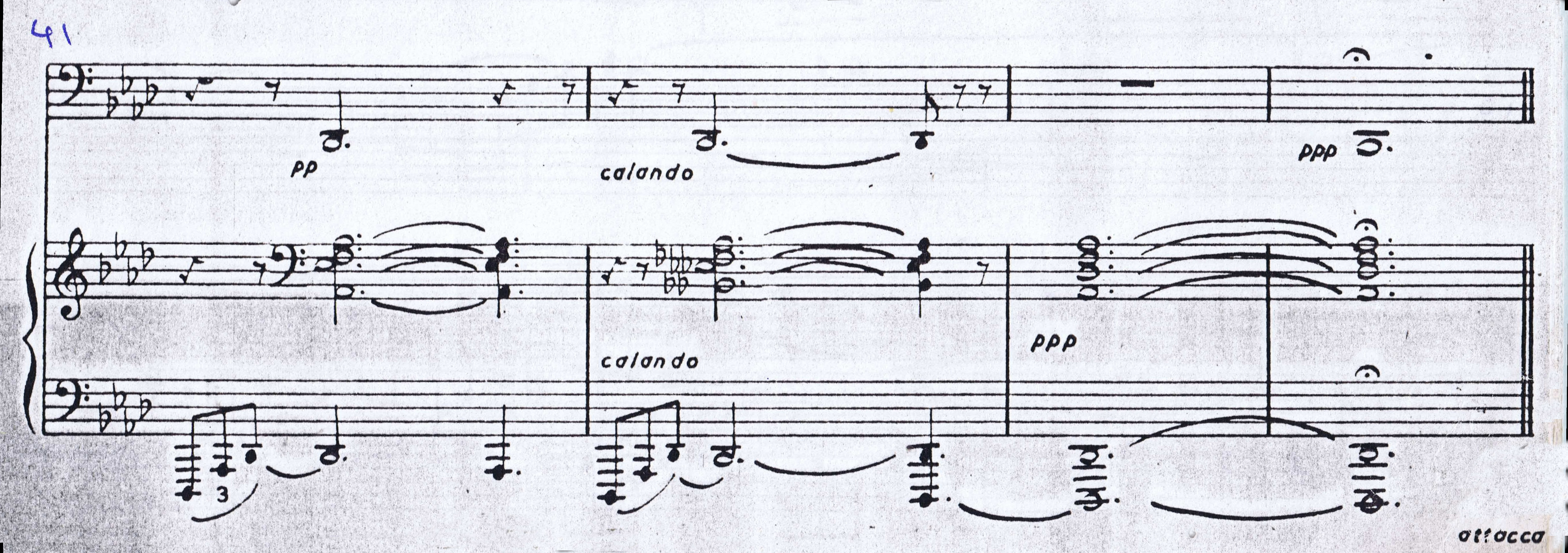
The finale recapitulates the opening first movement material to unify the work. It was available for some years on an Australian Columbia recording by John Kennedy and the composer in 1951 (LOX 811/2,78 rpm); this is possibly the only known recording of Bainton as pianist and shows him as a first-class interpreter.
This sonata, however, is relatively lighter fare when placed beside Bainton's Sonata for Viola and Piano of 1922; not only is this original and powerful work one of the very finest of Bainton's whole output, it is also one of the greatest viola sonatas of its time. The initial idea of writing such a work come from the late Lionel Tertis (1876-1975), whose artistic example did a very great deal to establish the viola as a solo instrument during the first half of this century, and for whom many works were written by the rising generation of British composers. In Remembered on Waking Helen describes Tertis's visit to the family home in Newcastle to try over the sonata, which she describes as “..a beautiful work, having that song-like quality which is so much a part of the composer's creative sense.”3 Sadly, Tertis never played the sonata, and its first performance was given by Helen and her father on Monday, 12th October 1942 (9.30pm) on the ABC Radio National Programme “The Composer Performs”, at which time Helen was a viola-player with the Sydney Symphony Orchestra. Its first public performance was given at a concert at the Birmingham and Midland Institute on Thursday 4th.May 1989, by Martin Outram, viola and Michael Jones, piano.
The sonata is in three movements and is written in progressive tonality (E minor - A minor - D minor). The “song-like quality” dominates much of the viola writing which covers a wide range, both technically (frequently going up to third position) and expressively. Bainton captures a unique mood in the work - part autumnal, part elegiac, and deeply reminiscent of past experiences. This is expressed in a passionately intense and fast-moving harmonic language. The first movement (Allegro moderato) is written in two sharps, as in B minor, but the tonal centre is clearly E minor throughout. Both instruments start together and the opening theme (Example 5a) with its two cells (x of Example 5a and Example 5b), casts a shadow over the whole work.
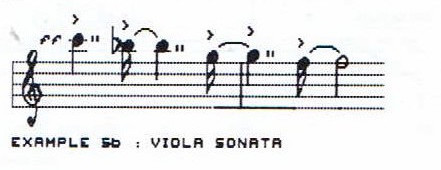
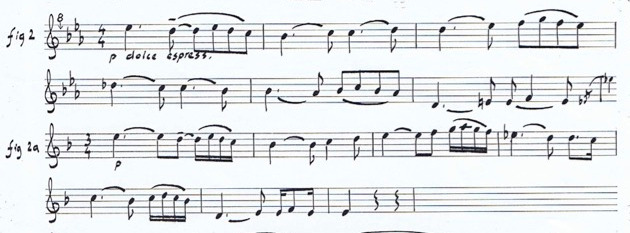
The first of these is Example 5b - a jagged and brutally syncopated idea, synchronising with the piano right hand against the left. This subsides into the second subject (Example 6a) in C minor (poco meno mosso), one of the most important themes as it appears in various guises throughout the work. It is a melody of deep nostalgia and exploits the ethereal treble range of the viola. This section leads straight back to tempo 1 (Example 5a) for the beginning of the development; here for the first time we hear x of 5a introduced into the texture by the viola, which will prove so crucial in the Finale. Example 5a returns again at the recapitulation its condensed material leading straight to Example 5b and then to Example 6a. There is a brief coda, the opening theme returns ‘con sordino’, ending on an unresolved F♯.
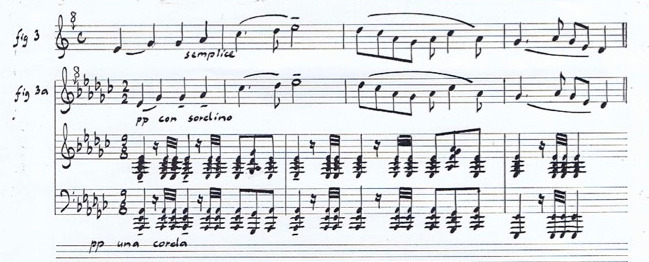
The feeling of tonal ambiguity is carried over to the second movement, which begins with an unaccompanied viola theme (Example 7a) in the manner of a traditional folk-song, strongly conveying to the ear a feeling of C major, though revealing itself to be A minor at its end. Bainton's use of folk-song material here is totally out of keeping with his general style, but the reason for this will become apparent later. As well as the restless, progressive tonality, the sonata is very forward looking in its use of crossing bar-lines, creating an ‘out-of-phase’ effect between the two instruments and in the simultaneous combination of slow movement and scherzo, as will be explained.
After the opening Allegretto con moto theme, the piano enters at double speed with a jerky scherzo-like theme (Example 8).
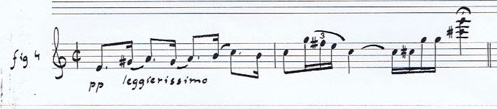
Tempo 1 and Example 7a return but here the viola plays against a 3/4 accompaniment. A few bars later we are back to ‘doppio movimento’ and Bainton ingeniously combines slow movement and scherzo by having the viola play part of the opening theme at half-speed, adding further to the confusion by reverting to 3/4 time on the piano. This must be one of the first attempts by a British composer to use a cross-bar-line technique, though he had already done so in his Concerto Fantasia of 1920, as we have already seen, and such a method forms a substantial part of the construction of the Violin Sonata in A of Bainton's exact contemporary, Ildebrando Pizzetti. This sonata was published in 1919 in England (Chester's) and, as a classic of its time, could easily have been known to him. Before the scherzo officially recapitulates, we have already heard Example 6a again, this time in A minor but sounded at the fifth, not the third, as in the first movement. The recapitulation is in F♯ minor; Example 6a still interrupts but with a feeling of uncertainly created by the broken pauses in the four-bar phrases. The Scherzo than resumes, ending in A minor with a final sounding out of the first phrase of Example 7a drawn out in half-speed against the piano.
The Finale (Adagio non troppo, maestoso) is the most powerful and dramatic movement of the work and unifies the already taut strands of melodic structure that have bound the work together. The piano boldly and dramatically sounds out Example 5c which, as we have already seen, is closely built out of the very first idea in the sonata, violent demisemiquaver reiterations express a military mood, which is taken up by the viola; this dominates the movement and begins to reveal the true spirit of the work. Shortly a new, very eloquent theme, drawn from bar 3 of Example 5a sounds out on the viola above the military rhythm, and leads to Example 6b which is a variation on the by-now familiar second subject theme. This rises to a climax in the piano and is taken over by the viola.
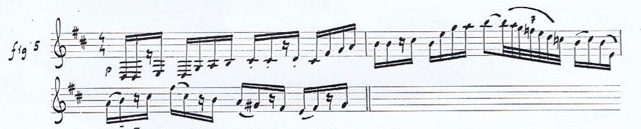

The mood then changes abruptly to Allegro con fuoco and a new idea, Example 9a, is expressed in an urgent, restless rhythm which reaches a fortissimo of demisemiquavers at the end of the phrase. Piano and viola take up Example 9a against off-beat left-hand chords and this builds up to a triumphant climax (Example 9b) almost like a peal of jubilant bells.
After this section, we reach the heart of the movement and the meaning of the work. The key is now A♭ major; the military rhythm proceeds in the background on the piano in 9/8 time, and the folk-song theme from the second movement (Example 7a) now becomes Example 7b - in A♭ minor and ‘con sordino’ but still in duple time, proceeding like a disembodied spirit above the distant military machine. This innocent folk-tune, the song of rural youth, is now the lost soul of the First World-War soldier. Thus we have Bainton's own exorcism of his feelings of that period, his own Morning Heroes. After a short piano passage, the Allegro con fuoco returns in condensed form, leading straight into the final optimistic peal of triumph and joy; the second-subject theme (Example 6a) having the last word before the final ascent to a prestissimo climax in D major - Bainton's innate belief that spiritual things inevitably triumph over even the greatest adversities. I would like to see this remarkable 25-minute work take its place in the repertoire.
Considering the exceptionally high standard of the northern choral societies at the turn of the century, it is inevitable that Bainton would be drawn towards writing for them. We get a glimpse of their achievements in the autobiography of Sir Henry Coward, published by Curwen in 1919. Perhaps the greatest choral conductor of his time, he has this to say of the Newcastle and Gateshead Choral Union Festival of 1909:
“Every work went magnificently. Every composer was in raptures. The whole festival was a triumph musically, financially and socially. The choral singing was as remarkable in its way as the first Sheffield festival, and if the edge of wonderment had not been forestalled by that epoch-making event, it would have called forth as great an outburst of surprise and congratulation from the press.”
From this it seems likely that The Blessed Damozel was given an ideal performance at the Newcastle concert on the 22nd November 1907, conducted by the composer, with Elgar's The Dream of Gerontius conducted by Coward in the second half. The text by Dante Gabriel Rossetti was hardly unknown to British Composers. Bainton's setting for mezzo-soprano, baritone, chorus and orchestra, was worked over from June 1906 until the following March, and it is his first important work in this medium. (His notebook lists a Mignon's Requiem for boys' voices, chorus and orchestra of March 1904, but this was probably withdrawn). One is already aware, even in such an early work, of great flexibility and sensitivity of harmonic flow in the vocal texture with its sub-divided parts for the male voices and occasional high tenor parts - a typical characteristic of Bainton's tenor writing. Bainton also keeps the chorus on their toes rhythmically with a section of varying 9/8 and 12/8 bars, (at “We two, she said, will seek the groves where the Lady Mary is”). Although his melodic lines have an Elgarian feel to them, any element of derivativeness is guarded against by the overall level of inspiration and onward sweep of imagination. The performance probably lasted in the region of 30 minutes and I see no reason why this work should not compare well with other contemporary settings as the product of a young, highly-gifted and promising composer beginning to find his feet. Dorking Performing Arts Library have a set of vocal scores available, but the full score and parts are now part of the Mitchell Library collection.
1907 also saw the completion (between 3rd April and 16th December) of the vast and rather ambitious choral symphony Before Sunrise, for contralto solo, chorus and orchestra (from Swinburne's Songs Before Sunrise) which was published by Stainer and Bell in 1920. It was the first of Bainton's work to receive a prestigious Carnegie Trust award in 1917, the first year of these awards. Other presentations included Vaughan Williams's A London Symphony, Frank Bridge's suite, The Sea, Howells's Piano Quartet in A Minor and Rutland Boughton's opera, The Immortal Hour.
The work is in four movements, Genesis - Tenebrae - A Watch In The Night - Hymn of Man, the first movement is purely orchestral, acting as a prelude which presents several themes heard throughout the symphony, ending in a fanfare-like idea which will re-appear significantly in the Finale. The Tenebrae movement includes the first contralto solo, “At the chill tide of the night”, which is accompanied by material from the opening section of Genesis; this leads to a very Elgarian theme for the first chorus entry of the work, “O Spirit of man” which will return in the finale. After the stormy opening of the third movement, the basses declaim, “Watchman, what of the night?” “Storm, thunder and rain,” answer the chorus, setting the tone of the movement. In the Hymn of Man, the fanfare motif rings out like a fanfare in triumphal glory, and the 47-bar orchestral opening brings in other themes from the first movement and rises to a climax before diminishing to the first chorus entry “In the grey beginning of years”. Eventually the Genesis theme re-appears, and the Elgarian theme is the setting for “For his face is set to the East”or parts. Eventually we arrive at the Coda, a bracing allegro molto in contrapuntal style with the sopranos declaiming “Glory to Man in the highest”, which is taken up by the rest of the chorus, the fanfare motif having, expectedly, the final word.
By the time of the symphony's first performance, by the Newcastle and Gateshead Choral Union, on 6th April 1921 I have the impression that it must have already begun to sound dated. I feel that such a work, having been finished fourteen years earlier, was too ambitious a project to undertake successfully at that time. Although well constructed and effectively written for the chorus, the thematic ideas are not amongst Bainton's finest inspirations: also, the general thematic development is highly sequential and formula-bound, perhaps in the way that his former professor, Stanford, to whom the work is dedicated, would have approved. The shadows of Elgar, and even Mendelssohn, found there detract from its being seriously considered as a work of promising originality; by the time of its completion it would have had to compete with Vaughan Williams's A Sea Symphony, destined for the 1910 Leeds Festival, Delius's A Mass of Life, and Holst's Hymns from the Rig Veda. After 1921, competition with Holst's Choral Symphony and Choral Fantasia, Constant Lambert's The Rio Grande and Walton's Belshazzar's Feast, and with the highly imaginative, original and enterprising Psalm 139 and Requiem Aeternam of his friend W G Whittaker, would surely have relegated Before Sunrise to a distant backwater. Perhaps it would be worthwhile to hear a modern performance (performing materials readily available), but the low tessitura of the solo part requires a real contralto, not a present-day mezzo-soprano, and this would add further difficulties to a modern performance.
1908 saw Bainton's less ambitious attempt at a large-scale choral work, The Transfiguration of Dante, Op.18. Started in May that year, it had reached vocal-score form by December and is now part of the Library of the Birmingham Conservatoire. It opens with a choral prologue, Spirit of Flame, for unaccompanied double chorus of 3-4 minutes duration, and shows the confidence Bainton had in the choirs at his disposal. Even in this form, the themes and motifs for the principal characters, Dante, Beatrice, Angelo, Prior and Death, are clearly delineated and thoroughly worked out, though I suspect some modifications would have been made in subsequent revisions. The next choral works were Sunset at Sea, Op.20, premièred on 25th March 1912 and The Vindictive Staircase, on 18th March 1914, both given in London by the Edward Mason Choir and Orchestra, conducted by Edward Mason both published by Stainer and Bell, (1912 and 1913) who held performing materials on hire. Bainton would clearly have known the librettist of the first, Reginald Buckley, through his friendship with Rutland Boughton; his second librettist, Wilfred Wilson Gibson was a personal friend. Gibson wrote two ‘choral humoreskes’ for Bainton and their element of imaginative fantasy produced some of his most colourful music. By 1910 he had sketched ideas for a work based on excerpts form Edward Carpenter's Song of Democracy, a piece also set by Boughton. but it was not until 1920 that these found their final form as A Song of Freedom and Joy, published by Curwen in 1919 and premièred in Newcastle that year. As the full scores of these three works are missing, it is impossible to give a full account of the choral and orchestral texture.
Bainton's appearance at the Three Choirs Festival of 1921 led to a commission from Dr. Percy Hull for a choral work for the 1924 Festival. This was The Tower, to words of Robert Nichols, completed on 17th September and published by Curwen; its full score is now in the British Library. We are now entering the greatest period of Bainton's work, and I would consider the next two choral works, The Dancing Seal, another humoreske of Gibson's and A Hymn to God the Father, to words of John Donne, (along with The Tower, his only overtly religious published choral works) as two of his very finest works. Both were published by Oxford University Press in 1925 and 1926. The Dancing Seal might seem a little dated in its narrative today, but the choral writing is brilliant and demanding, with intense harmonic activity and wide range of tessitura, particularly for the tenors. The scoring is clear and economical, but nevertheless highly colourful and effective especially in the Debussyesque middle section, a real fantastic rout. Compared to this A Hymn seems almost a confession of sins! First performed at the Worcester Festival in 1926, this is a short though effective and dramatic piece, seemingly restrained in emotion yet deeply powerful in sound. On the words “I have a sin of fear”, the choir divides into eight parts with a canonic avalanche of one part after another; this builds to an imposing climax for double choir with further additional parts and a final tranquil ending. At under 10 minutes it is a very under-rated work which deserves more frequent performance; the full score of this and The Dancing Seal are available from the composer's estate.
After this high point, Bainton left two more choral works complete but unpublished; To the Name above Every Name, to words of Richard Crashaw (1928), and The Veteran of Heaven (Francis Thompson) of 1931, both in the Mitchell library. It is not known if they were orchestrated, perhaps by this time he was already looking towards a more purely orchestral means of expression. During his summer holiday in 1933 when he heard the news of his appointment to the New South Wales Conservatorium, Bainton had been working on a tone-poem based on Swinburne's Thalassa; this was put aside in the turmoil of moving to a new and exciting future. During a holiday at Bundenoon in the Southern Highlands of New South Wales in 1939, he took up the sketches once more and expanded them into his Symphony no. 2 in D Minor which received its première with the Sydney Symphony orchestra, conducted by the composer, on September 11th 1941. It was well received and Neville Cardus regarded the work as a tribute to the apotheosis of a great period in English culture. It consists of three main sections played without a break and lasts 26 minutes. The opening chorale, played on a quartet of horns against bass pizzicato, has a sense of anguish which establishes the mood for the whole work. It gradually builds up to a stormy climax, followed by an allegro section in a rather windswept vein which then subsides into the mood of the opening in the manner of a triumphal chorale which we shall hear again at the end of the symphony. This is immediately followed by a scherzo in a dotted 6/8 rhythm; the outline of the theme used here is in slower tempo in the Trio and is a reminder of the opening chorale of the symphony. There is a famous family story connected with the extraordinarily beautiful opening of the slow introduction to the Finale, with its sustained strings in D major, its swirling woodwind harmonies and ethereal flute theme. Bainton loved listening to bird-song (hints of Messiaen?) and, during the holiday at Bundenoon, heard the most ravishingly beautiful example of this, but was unable to trace the elusive bird, much to his annoyance and that of his family who were dragged into the adventure! This opening, a brief glimpse of heavenly light, soon subsides as the basses begin to re-create the original mood and the opening material which has bound the work together from the start, returns.
This symphony, cleanly and colourfully scored, is very accessible at first hearing, and yields up further treasures on later experience. It deserves to be heard more frequently in Britain, as it has been in Australia, with broadcasts by various conductors over the last 35 years, including Joseph Post, Myer Fredman and the composer himself. Its MS score and parts are held by the ABC Federal Library at Sydney. It is one of Bainton's most important works and there is still more to come: the Symphony no. 3 in C Minor very nearly remained unfinished. Bainton began it in 1952 and was working on the slow movement in 1954 when his wife became ill and died unexpectedly. His deep distress made him put the symphony away and it was nearly forgotten. Gradually, however, with the support of family and friends he came back to the work and was finally able to release his anguish by completing it. The last sixteen bars took months to satisfy his always fastidious mind and the work was finished by 1956; he knew it was amongst his very finest work and wrote nothing else after it. He did not live to hear the première which was given by the Sydney Symphony Orchestra under Sir Bernard Heinze in 1957, a performance recorded and issued on the BROLGA label (LP). Helen has described it as “a model of rich and immaculate orchestration - almost Renoiresque in its searching out of orchestral colour.” The harmonic language is more advanced than the second symphony and the overall intensity and sense of imaginative fantasy greater. The dawn-like opening chords, molto adagio, have solos for woodwind and horns over sustained strings which give way very quickly to a stormy allegro con brio in which a rhythmical phrase from the bassoon is tossed about among all the instruments and the movement progresses. The tempo slows to andante with many interesting and beautiful effects before changing to 12/8 time and gradually building up to allegro vivace. Thereafter various sections are well contrasted with each other and lead to a con fuoco passage which dies away to the mood of the opening. The second movement follows ‘attacca’ and is an allegretto grazioso described by Helen as a “chuckling scherzo”, beginning with a sequential theme on clarinet taken up by the flute. The mood is still very much that of the first movement, indeed this mood is sustained throughout the symphony. The pace slows to molto piu lento with another theme on the clarinet, developed with rich treatment until the shades of the first theme recur in the strings. Everything becomes more animated again and ends fortissimo. The slow movement has been described by the writer and poet Franz Holford as Bainton's Sea Drift and is a deeply emotional piece of writing, opening with a pensive figure sounded on low strings, repeated on bass clarinet and treated as a dialogue between. strings, woodwind and horns. Halfway through, a beautiful theme, marked tempo di pavane is introduced by the strings; Helen remarks that her father “makes the interesting experiment of scoring the violas at an octave above the violins, to achieve a greater sonority”, but I maintain that Bainton knew full well what effect he wished to achieve, having already done this in A Hymn to God the Father when the violas and cellos sound out an octave above the violins in the first section, 30 years earlier. The last movement is built on “a heavily marked and rhythmical motif in 3/2” with powerfully scored climaxes. A poco lento section in 3/4 time is a good contrast in the middle section and the melodic material has a pentatonic feel to it. We also hear reminiscences from earlier material in the symphony, and a noble and sonorous theme, played towards the conclusion by the strings, leads to the final climactic molto maestoso, adagio, ending on a note of triumph.
Helen Bainton has described her father's Third Symphony as “the epitome of his whole life and thought”, and with it, Bainton came to the end of a rich and fulfilled life of music; a life in which he was constantly giving without seeking for personal gain, and in which he strove to create profound and beautiful expressions which he was content to put aside for performance at some future time. As so much of his most significant output remains in Australia, it has only been possible to give a partial assessment here; furthermore, the climate of opinion that has prevailed throughout this century, with its obsession with materialism and scientific progress, has seen fit to obscure the real value of the creative artist as exemplified by Bainton and so many of his British and continental contemporaries who represent a maturing of tendencies. In 1990, the 110th anniversary of his birth, we should endeavour to take stock of what he, and they, have left us, in order to enrich our understanding of a great and glorious period of British and Western music of which, to date, only a relatively small proportion has been uncovered.
ACKNOWLEDGEMENTS
Special acknowledgments to:
Miss Helen Bainton, Mr Denis Dodds, Professor David Tunley of Western Australia, Dr Hans Forst, Australian Music Centre (Angela Lenehan), Mitchell Library (Paul Brunton), New South Wales Conservatorium Library (Claire McCoy), ABC Federal Library (Daphne Maguire, Greg Nathan), National Film and Sound Archive (Jean Wein), Bournemouth Music Library (W J S Date), Newcastle Library (F W Manders), Michael Hurd and the Rutland Boughton Trust, British Library, the late Lady Hull.
(from: “Edgar Bainton: Musical and spiritual traveller” by Michael Jones
written for the British Music Society and first published in ‘http://www.musicweb-international.com ’, 1990 )
NOTES
- Stanford, the Cambridge Jubilee and Tschaikovsky, Gerald Norris (Publ. David and Charles, 1980 p. 545).
- Musical Notes, (Ruhleben Musical Society) pp. 48-9 courteousy Roger Noble.
- Remembered on Waking, Helen Bainton (Currawong Press, 1960 pp. 66-7).
- ibid. pp 77-8.
- ibid. p.41
- Letter from Dr Hans Forst to the author, March 9th, 1989.
- Remembered on Waking pp 98-9.
- ibid.
- ibid. p.38.
- ibid. p.91.
- My Life of Music, Sir Henry Wood (Gollancz, 1938, p. 229).
- Programme Note to the Bournemouth Municipal Orchestra Symphony Concert No 4, October 1903, courteousy of Bournemouth Music Library.
- Remembered on Waking p.38.
- The Reminiscences of Henry Coward (Curwen, 1919).
- Helen Bainton - programme note for the 1957 première of the Third Symphony.
- ibid.